


‘Everything I’ve Wanted Said to a Judge’
Neel Lalchandani’s fight for wrongfully convicted exonerees
Published in 2026 Maryland Super Lawyers magazine
By Artika Rangan Casini on December 18, 2025
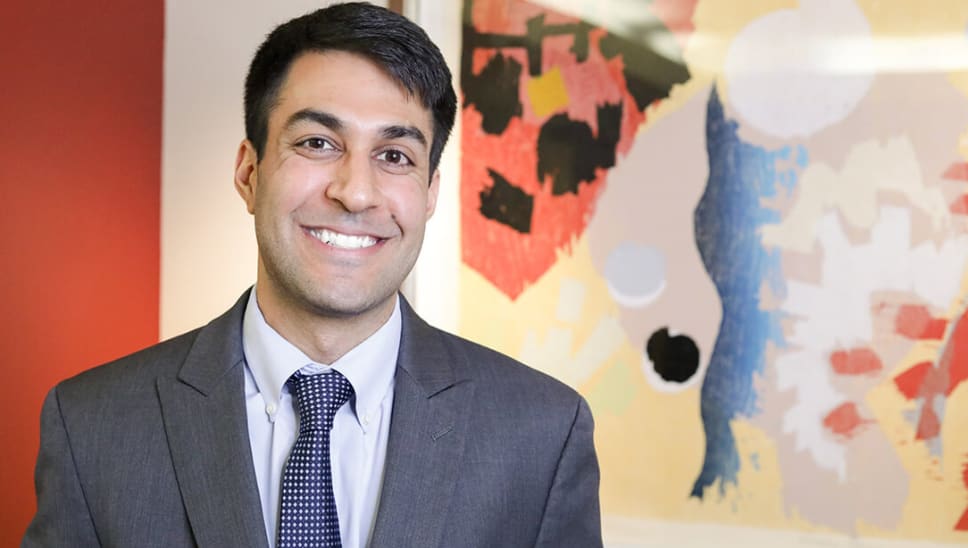
When Neel Lalchandani meets a new client who’s been exonerated of a crime, he begins not with legal paperwork, but with a simple question: “How are you doing?” For people who’ve spent years, sometimes decades, being treated like a case file or criminal record, it’s no small thing. Nor is Lalchandani’s role in helping them seek compensation, either in state or federal courts.
“[With state cases], the goal is to prove that your client was factually innocent,” Lalchandani says. “When you’re in federal court, the question isn’t whether someone is innocent or not; it’s whether their constitutional rights were violated. That’s the cases where officers hid evidence or fabricated evidence or coerced witnesses. One way of thinking about it is: The first category is broader, and the second category is a subset of that first category. I’ve represented clients in both.”
Lalchandani isn’t the only attorney working with exonerees, but he has become one of the most visible, in part because of his involvement in passing the Walter Lomax Act, a 2021 Maryland law that standardized how the state compensates people for wrongful convictions. His campaign included rallying lawyers and advocacy groups after years of arbitrary, inconsistent compensation decisions by the state’s Board of Public Works. The new law ties compensation to Maryland’s median income and guarantees benefits like housing and education. “We’re making progress,” he says, “but we’re not done.”
Since it passed, Lalchandani has helped his clients secure more than $16 million in state courts. Federal cases bring the total to more than $80 million. But, he’s quick to note, money is only part of the picture.
“Some of my clients want a trial. They want to tell their story, be heard, have public reckoning. Others want to be done, move on with their lives, not relive the trauma of their past experiences,” he says of the federal cases. “You meet each person where they are.”
Last January, Lalchandani sat beside Tyrone Jones, who had served a decade behind bars before being exonerated of a conspiracy-to-commit-murder conviction. At a two-day Lomax Act hearing, Lalchandani called seven witnesses. After the closing statement, Jones turned to his lawyer and said, “This is everything I’ve wanted to be said to a judge for 25 years. Even if we don’t win, I feel like I’ve won.”
They did win, but as Lalchandani explains, “The relief in all these cases is nowhere close to sufficient for the suffering our clients endured.”
Reversing wrongful convictions requires legal acumen and the ability to earn trust from those who have been let down by the system at every turn. “In criminal cases, the state is at the height of its power. Someone’s life and liberty hangs in the balance,” he says.
He credits his firm for placing a strong emphasis on justice-oriented work. It has even hired a social worker to assist exoneree clients on everything from health insurance and personal finance to accessing mental health services.
Often, the systemic patterns of wrongful convictions are disturbingly familiar, Lalchandani says: tunnel vision by investigators, suppressed evidence, coerced statements, and always, the long aftermath of rebuilding a life after being imprisoned in error. He spent three years at Georgetown Law, co-teaching a course on wrongful convictions. His main lesson? Be skeptical of certainty.
“A lot of these convictions happened because someone thought they had all the answers,” he says. “Humility matters.”

Some post-exoneration cases stand out. Leslie Vass, convicted of a 1975 armed robbery he didn’t commit, received $550,000 in a Lomax Act case. Another client, J.J. Owens, refused to take an Alford plea that would have freed him years earlier because he wouldn’t admit to something he didn’t do. Owens later won a $9 million settlement in the federal case, donating a portion to the Innocence Project. Another federal case was the Harlem Park Three, exonerated after serving 36 years in prison—or 108 years combined—the longest wrongful conviction case in U.S. history. The victims’ settlement was a record, too: $48 million.
Lalchandani was one of seven lawyers who worked on the case, which he says was marred by coerced witness statements, racial intimidation and lost evidence. One of the clients, Alfred Chestnut, began his own reinvestigation from prison, writing letters and eventually unearthing police reports that had been withheld for decades.
“I don’t want to inflate my role, because it was a team effort,” Lalchandani says. “But I’ll never forget what those three men endured.”
It’s not always the dramatic moments that stay with him. Sometimes it’s a quiet conversation in a courthouse hallway. Mostly it’s knowing that someone—after years of being silenced—was finally believed.
“There’s anger, of course,” Lalchandani says. “But more often, I’m struck by my clients’ resilience. They’ve lived through the worst of what our system can do and still have hope.”
One of Lalchandani’s earliest cases involved the Gun Trace Task Force, a disgraced Baltimore police unit charged with planting evidence, stealing money and fabricating charges. He represented Umar Burley and Brent Matthews, who had claimed officers planted 32 grams of heroin in their car.
While this case was in federal court, there was another at the Supreme Court of Maryland concerning whether the city of Baltimore would be responsible for paying judgments. Because of how the court ruled, Lalchandani’s team saw a path forward for Burley and Matthews.
“This was not just a few bad apples,” Lalchandani says. “We helped build a coalition of other lawyers and survivors of this abuse who filed an amicus brief outlining this as a systemic problem.”
Ask Lalchandani what he wants to leave behind and he’ll say: anything to move our society in a positive direction. “Lawyers often represent people at the most difficult moments of their lives,” he says. “I want to help navigate that and do right by our clients.”
Search attorney feature articles
Featured lawyers

Helpful links
Other featured articles

Perennial listees discuss the past two decades of law

For Chris Hanslik, homelessness is not something that can be ignored

Larry Waters Jr. uses his J.D. to make change
Find top lawyers with confidence
The Super Lawyers patented selection process is peer influenced and research driven, selecting the top 5% of attorneys to the Super Lawyers lists each year. We know lawyers and make it easy to connect with them.
Find a lawyer near you