


Didn’t Fear the Reaper
Why mortician Jill Sauber made the jump to elder law and estate planning
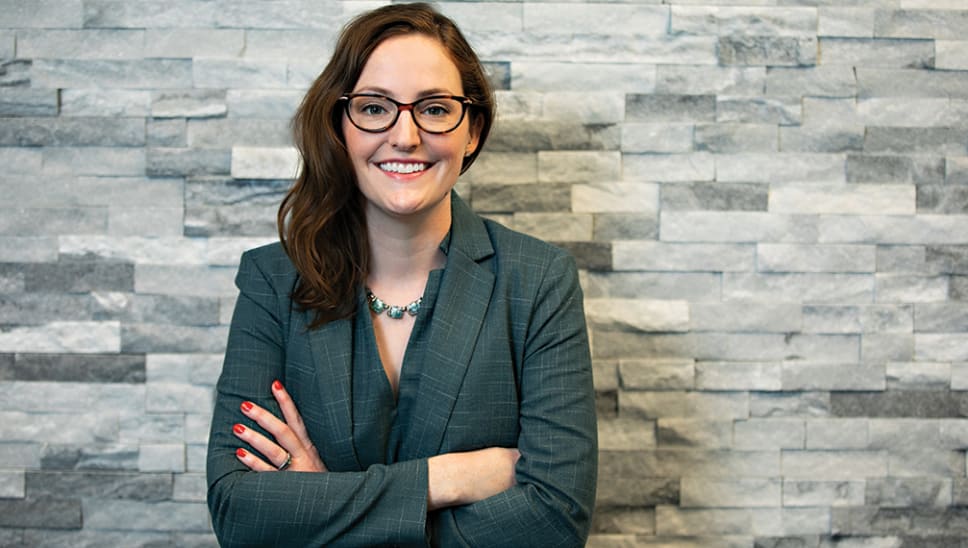
Published in 2025 Minnesota Super Lawyers magazine
By Karl J. Paloucek on July 11, 2025
Imagine becoming a licensed mortician—but just for a while, until you figure out what you really want to do in life. When Jill Sauber’s initial application to medical school was denied and her lifelong dream of becoming a doctor was temporarily derailed, she decided to pivot toward the accelerated mortuary science program at the University of Minnesota.
“I knew it wasn’t going to be my forever job,” says Sauber. “It was kind of an interim thing that I did, thinking I would reapply to med school. But then after doing service for a couple of years and getting my license, I realized, well, maybe med school isn’t what I want to do.”
Working with the dead wasn’t a big stretch for her—as a prospective M.D., she was prepared for dealing with bodies and all that entails. It’s obviously not a job for the squeamish, especially at its most challenging.
“I can recall instances where, despite our best efforts, my colleagues and I could not make the body presentable,” she says. “One was so badly burned from a car accident fire that the restorative products and cosmetics were no longer an option. Another was run over by a vehicle where there were no—or very few—unbroken bones in the person’s body, and the restoration meant attempting to restructure the bones and cover up protruding compound fractures.”
Sauber took it all in stride. “Morticians do all of this prep work, then take off all of the PPE, clean themselves up, put their full suit back on, and meet with the family members to do service arrangements,” she says. “After bank hours, when everyone else goes home, morticians stay on call to go out and pick up bodies and embalm throughout the night. Holidays, date nights and weekends are cherished because they are not always a given if you are on call. This is all in a day’s work.”
As it turns out, working with the living is what really surprised her. “I enjoyed being able to sit and talk to the families, and be that point person, that guide, to help walk them through this immediate post-death process,” she says.
Others said she had a gift for it.
“I had a former manager at one of the funeral homes who said, ‘I don’t know what you do in these meetings, Jill, but people are always laughing—they always leave happier than when they walked in,’” she remembers. “And I’m like, ‘Well, yeah—I don’t want to make them cry! We’re talking about their loved one and sharing stories.’ That was a really cool thing that I got to participate in. And I still do. As an attorney, I get to see some of that.”
When I applied to law school, I had no idea elder law was even a thing. Then it clicked: ‘Oh, this is exactly what I was supposed to do.’
Another thing she saw while working in funeral service: Not enough people had planned for what came next. “Their families were at a loss. I think that was the pivot point for me,” says Sauber, who’s now a Bloomington-based elder law and estate planning attorney. “I wanted to help the families to navigate all of this stuff. It was a natural transition. When I applied to law school, I had no idea that elder law was even a thing. And then, that clicked. That was like, ‘Oh, this is exactly what I was supposed to do.’”
A decade on from her practice as a mortician, Sauber still keeps up her license. It comes in handy. “I have cases occasionally related to mortuary law, or cemetery disputes,” she says. “I’ve done body exhumation cases, disinterments, reinterments—we have to disinter a body, maybe to do some genetic testing, for instance, or there’s a criminal case for disinterment, or they want to move the body to a different cemetery. All of those require court orders, and have to have the involvement of a licensed mortician in Minnesota, so I can act as that person.”
She sometimes misses the camaraderie of her fellow funeral directors, but she stays in touch with them, she says, because “morticians are just fun people to be around.”
“We don’t take things for granted,” she says. “We really enjoy life. And I think that that shows in the way we have gallows humor. We’re not joking about the person dying, but we’re joking about death in general. Sometimes death is funny, and it doesn’t wait. It’s coming for all of us. You just can’t dwell on it and think about it all the time. You’ve got to enjoy life. I think funeral directors do.”
Search attorney feature articles
Featured lawyers
Helpful links
Other featured articles

Tim Jacobson’s environmentalism touches law, filmmaking and beyond

Discovery with E. Grace Okorocha

Walter Kelley takes us inside his landmark wrongful death verdict against R.J. Reynolds
Find top lawyers with confidence
The Super Lawyers patented selection process is peer influenced and research driven, selecting the top 5% of attorneys to the Super Lawyers lists each year. We know lawyers and make it easy to connect with them.
Find a lawyer near you