


Bob Hilliard’s Advantage
Fearlessness has served him well, on the tennis court and in law
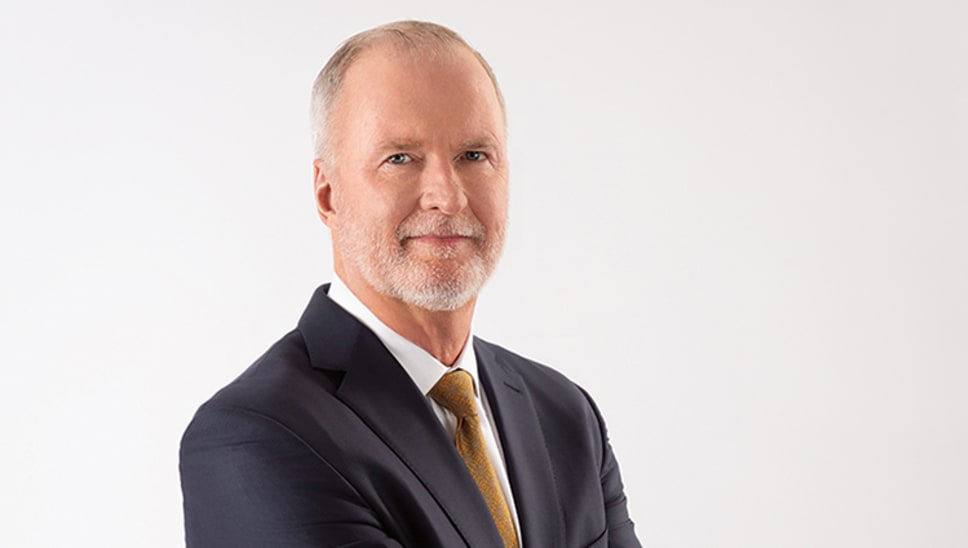
Published in 2025 Texas Super Lawyers magazine
By Carlos Harrison on September 15, 2025
To hear Bob Hilliard tell it, he was thinking more about clay courts than courtrooms when he took the LSAT.
“Law school was just a chance to play tennis for three more years,” he says. “That’s the way I looked at it.”
There´s probably a wink in there somewhere, but there’s truth too. Hilliard is plenty connected to the law. His dad was a lawyer; two of his kids are, too—working at his Corpus Christi personal injury firm, Hilliard Law.
But back then, tennis came first, he says, and it taught him the discipline needed to succeed in matches, law school—and afterward, as he built a one-man shop into two formidable Texas firms. It also helped foster the confidence to take on cases against such giants as General Motors and the U.S. government, and to argue before the U.S. Supreme Court.
“His competitive nature is huge. I mean huge,” says tennis buddy Tony Yvanovich. They started as rivals 40 years ago, then became friends and doubles partners. “It goes across his whole life. … You can see it in his work, and definitely in tennis.”
Tennis was a happy accident. Starting high school in Houston, Hilliard wanted to play basketball. Which makes sense, looking at him today, standing almost 6-foot-7. But at the time, he hadn’t hit his growth spurt.
“I was 5-foot-3,” Hilliard says. “The coach looked at me and he just goes, ‘Get out!’”

A school counselor suggested tennis.
“Turns out it was an aptitude,” he says.
Less than a semester later, his tennis days almost ended. His dad bought a law office in Newton, a town of 1,600 that didn’t include, from what Hilliard could tell after the family moved there, a single tennis player his age.
Hilliard persisted. He found a tennis pro in Beaumont who said, “If you can line up 10 lessons for me every Saturday in Newton, I’ll give you the 11th lesson for free,” Hilliard says. “So, all week, I’m trying to talk these country kids into getting their parents to pay for a tennis lesson.”
Come Saturday, Hilliard says, “I would sit there all day and wait and wait and wait until about 6:30 at night. I’d get my lesson.”
After graduation, he made the team at St. Edward’s University, where he devised his own training regimen. He ran 5 miles before dawn. He jumped rope for 30 minutes. After practice came 200 forehands, 200 backhands, forehand volleys, backhand volleys, forehand/backhand switched.
“Every single day for four years—if I didn’t have a tournament or match.”
By his third year, he was 12th in the country in the National Association of Intercollegiate Athletes. By graduation, he was St. Ed’s athlete of the year.
He decided to go pro. Hilliard played on the U.S. Tennis Association Penn National Circuit, which Sports Illustrated once described as “the road to glory, or the road to nowhere.” It’s composed of itinerant players hoping to earn tournament money and enough circuit points to move into the bigger tournaments, including the Grand Slam.
A few months in, after a particularly miserable match, Hilliard decided the law wasn’t such a bad idea. He got into St. Mary’s University School of Law in San Antonio, where he worked the books as hard as he’d worked on his backhand.
“I was the most disciplined law student you’ve ever seen,” he says. “I would get up every morning and study. I would outline. I would outline my outlines. I’d be in the library every single day after school. Except Fridays, when I would go play tennis.”
(He’s still playing tennis. In May, Hilliard landed the Level 2 national doubles title at Westwood Country Club in Austin.)
In his third year of law school, he met Corpus Christi personal injury lawyer Guy Allison at a party. Hilliard showed him how to shuck oysters. Allison hired him.
“I got licensed on a Thursday and he got me picking a jury on a Monday by myself.”
Two years later, Allison fired him. “He said, ‘There’s room for one rooster in this hen house, and you don’t seem to know who it is.’”
Hilliard started a firm of his own. It was tennis all over again: Work relentlessly. Win some. Lose some. Apply what you learned.
His notable cases include a $575 million settlement from General Motors over faulty ignition switches and a $310 million jury award against the maker of the Orlando Free Fall attraction, after a 14-year-old fell to his death.
The firm grew. Its 30 attorneys now include his wife, a daughter and a son.
In 2012, Hilliard opened a second firm dedicated to social justice and antitrust work with college tennis teammate Steve Shadowen. That’s how he wound up before the U.S. Supreme Court on a case in which a bullet fired by a Border Patrol officer in Texas killed a 15-year-old boy across the border in Mexico.
“I literally had to quit practicing law for six months to prepare. It was like starting to train to be a good tennis player. I said, ‘I may not be great when I get up there, but I’ve just got to do this right.’”
He did—he got the case remanded. On its return to the U.S. Supreme Court, argued by an outside attorney, the high court ultimately ruled the family could not sue over the shooting. Hilliard’s firm is pursuing a different tactic: petitioning the Inter-American Commission on Human Rights to hold the U.S. government responsible for the death.
Hilliard’s approach to litigation reminds Shadowen of his law partner’s tennis mindset.
“That was really the way he played in college,” he says. “It wasn’t reckless risk-taking, but it was a fearless risk-taking.”
Search attorney feature articles
Featured lawyers
Helpful links
Other featured articles

Monica Shah is driven to represent those facing down powerful institutions

Julius Kim’s time as a Milwaukee ADA made him a better defense attorney

Attorneys share their memories of the heart-wrenching and historic Detroit bankruptcy case
Find top lawyers with confidence
The Super Lawyers patented selection process is peer influenced and research driven, selecting the top 5% of attorneys to the Super Lawyers lists each year. We know lawyers and make it easy to connect with them.
Find a lawyer near you