


One Good Man
How a JAG case involving Don Marcari led to A Few Good Men

Published in 2026 Virginia Super Lawyers magazine
By Carlos Harrison on April 17, 2026
First things first.
Yes, he can handle the truth. And no, he wasn’t thinking about movies when the case that inspired A Few Good Men fell into his lap. In fact, he hadn’t been thinking about the military in the first place. The law wasn’t even Don Marcari’s first career choice.
When the founder and managing partner of personal injury firm Marcari, Russotto, Spencer & Balaban started classes at Appalachian State University in North Carolina’s Blue Ridge Mountains, he had only one clear goal: Get a degree.
His dad was the plant manager at an aviation parts manufacturer and his mom ran the household. “Neither one of my parents had a high school diploma, so I knew from a young age that I was going to college,” he says. “It didn’t matter what I got a degree in, but I was going to college.”
Marcari got a B.S. in political science with a minor in business administration, then a master’s in public administration. He became an assistant city manager right out of grad school at 21 and, at 23, “the youngest city manager in the nation,” he says proudly.
“I always was interested in the law and politics,” he notes, “but I had nobody to really guide me.”
After two years as city manager in Lake City, South Carolina, Marcari decided to head to law school. “I was 25 and single, and I figured if I ever wanted to do it, then was the time.”
He was accepted at Campbell Law School in tiny Buies Creek, North Carolina. “There was nothing to do but study,” he says. “If the law school would have been in Raleigh, I would have flunked out after the first year.”
He had a job lined up with the attorney general’s office in North Carolina when, shortly before graduation, fate stepped in.
A law school friend wanted to meet the Air Force JAG recruiter at the college and asked Marcari to accompany him. While he waited, a Navy officer in gleaming dress whites stopped and asked, “Are you interested in the military?” Marcari recalls.
“I said, ‘No. No, sir. Thank you. I’ve already got a job.’”
They chatted a bit more and Marcari kept saying no—until the recruiter said the magic words: “You got any law school loans? … We’ll defer all those till you get out,’” Marcari remembers. “The next day I was in Raleigh. … As soon as I got there, we were in court. I mean, we were trying murders, rape, drugs.”
He wound up on the JAG Corps mobile trial team. “We would try cases seven days a week; 10, 15 hours a day,” he says. “I couldn’t ask for a better trial experience.”
One of those early cases involved a code red at Guantanamo.

A Few Good Men doesn’t claim to be based on a true story; however, screenwriter Aaron Sorkin’s sister, a Navy JAG officer, told him about her involvement in a case in which several Marines faced attempted murder charges over the assault of a fellow Marine.
In the real-life case, no one died. No one faced a life sentence at Leavenworth. And Marcari wasn’t a slick, dealmaking JAG officer coasting through his time in service between batting practices. In reality, 10 Marines got charged with attempted murder after a fellow Marine was tied up and gagged. The Navy and Marines share a legal system, and Marcari represented Marine Lance Cpl. David Cox, who insisted he was following orders.
There was no “You can’t handle the truth!” moment, but the jury agreed Cox had followed an implied order. “He was found guilty of simple assault and got to stay in,” Marcari says.
(In a bizarre footnote, two years after the movie came out, Cox’s body was found on the banks of the Charles River near Boston. The murder remains unsolved.)
Marcari left the Navy after one hitch and teamed up with a buddy to launch a general practice firm in Virginia Beach.
“One day I’d be in traffic court, criminal court, JDR court, whatever I could do to make a little money,” he says. “And writing a few wills on the side—whatever came in. I call it the ham-and-egg circuit.”
After six years, he joined Joynes and Bieber. “They said, ‘Look, why don’t you come; just do civil work, car crashes.”
A couple of years later, the firm became Joynes-Marcari, and four years after that, Marcari and about a dozen other attorneys split off to launch what is now Marcari, Russotto, Spencer & Balaban, focusing primarily on personal injury and wrongful death cases involving motor vehicle accidents. They also handle matters involving veterans’ disability benefits.
One of the first people he brought on board was Steve Foti, a former Navy career officer who became Marcari’s chief financial officer. They stayed together 23 years, until Foti retired in 2017, building the firm from three to 15 locations.
“With Don, what you see is what you get,” Foti says. “He’s a true human being. He possesses compassion, empathy for those of us who may not have as much, and provides the ability for them to level the playing field. I appreciate, and always have, his sincerity and his ability to sort out complex issues—to separate the noise from the signal.”
Along the way, Marcari took on some formidable cases—against Ford/Firestone, Walmart and Home Depot, among others. He racked up seven-figure verdicts and settlements in cases involving deadly tire tread separations, a faulty wheel replacement resulting in a fatal crash, and an unqualified driver behind the wheel of a delivery truck that caused life-altering injuries to another driver.
But every case, Marcari says, involves more than jury awards and settlements. “A difficult part of my job is trying to quantify for someone their damages, their losses, their pain and suffering. You can quantify medical bills and lost wages, but the biggest impact these cases have is on the people’s physical well-being, emotional health. Not to be able to shower on your own, not be able to cook for yourself, not be able to go out and take a walk, to walk the dog—just the simple things that have been taken from a person. So how do you put a dollar amount on that?”
Cristal Rouse and her six siblings hired Marcari after a truck slammed into their father’s Hyundai and killed him in April 2024. The case settled for seven figures.
“He held our hand through the entire process,” she says. “It’s multiple siblings, definitely some family drama there. But he was still able to speak with everyone, deal with the multiple personalities of my family, and be clear about what it was that he was doing.”
Personal injury may account for the bulk of the firm’s work, but Marcari never got too far from where it all started. He’s handled an array of military cases ranging from courts-martial to murder, including successfully defending a Navy commander in the Tailhook sexual assault scandal. That case, too, led to a movie.
Now, Marcari and the firm have created a Camp Lejeune section to fight for disability payments for service members and their families exposed to cancer-causing “forever chemicals” in the base’s water. “We’ve probably got close to a thousand clients or better.”
That’s quite a few good men and women.
The Sequel
Marcari calls A Few Good Men “one of the best legal movies ever.” In fact, he’s working on his own screenplay that would be a sequel. “It’s at Kaffee’s end of his career,” he says. “I figured, you know, there’s never been a follow-up to A Few Good Men. … I’ll let you know if it goes anywhere.
“My dream is, you know, you sell your screenplay and don’t have to work anymore.”
Search attorney feature articles
Featured lawyers
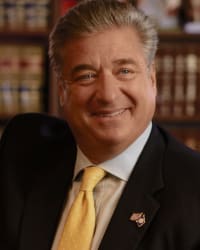
Donald W. Marcari
Top rated Personal Injury lawyer Marcari, Russotto, Spencer & Balaban Chesapeake, VAHelpful links
Other featured articles

How to get your Social Security disability benefits—even if you’ve been turned down

For Mo Hamoudi, that’s the path to overcoming childhood trauma

What to do—and not to do—when your insurance claim is denied
Find top lawyers with confidence
The Super Lawyers patented selection process is peer influenced and research driven, selecting the top 5% of attorneys to the Super Lawyers lists each year. We know lawyers and make it easy to connect with them.
Find a lawyer near you