


In the Line of Fire
First in the forest, now in the courtroom, Rod Nelson fights wildfire

Published in 2025 Washington Super Lawyers magazine
By Nina Schuyler on July 31, 2025
When Rod Nelson was a young man in the 1970s, he worked for the U.S. Forest Service as a firefighter, jumping into helicopters that flew deep into the forest to battle blazes in southeast Washington.
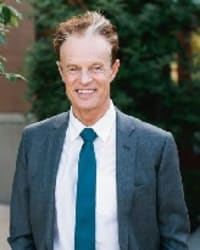
Today, Nelson is one of the Pacific Northwest’s leading legal experts on wildfire claims. Over the past 12 years, he’s recovered more than $90 million for hundreds of victims.
Back when Nelson was working as a firefighter, “There might have been as many fires,” he says, “but they were much smaller and a lot easier to control.” He spent a lot of time at the fire camp, waiting to spring into action. Those were the days. In 2024, according to the state’s Department of Natural Resources, 308,000 acres burned in Washington, up from 151,000 the year before.
“The primary cause,” Nelson says, “is climate change. It’s hotter and we have drought conditions in the Northwest. There is also a good argument that climate change has increased the velocity of winds. That not only gives fire more oxygen but also makes them much harder to fight.”
A century of fire suppression, starting with the U.S. Forest Service’s efforts in the early 1900s, also inadvertently contributed to larger fires, some experts say. Recently the Forest Service has increased controlled burns, not just in areas that have been clear-cut but also where there is a lot of debris on the forest floor.
Then there are electrical system failures.
“I see our aging and, frankly, just plain antiquated electrical grid as a third big factor in the increase of wildfires,” Nelson says.

Back in 1982, Nelson co-founded Abeyta Nelson Injury Law, where he has practiced plaintiff’s personal injury law for 45 years. His practice dramatically changed in 2012 when he received a call from Kenneth Roye, a California attorney with expertise in wildfire cases. Roye asked if Nelson was interested in this practice area, because he was receiving many calls from people who suffered property damage after the 2011 Monastery Fire.
The Washington State Department of Natural Resources, which has a statutory obligation to investigate every fire, had just issued a report finding that a defective part in a truck had sparked the flame.
Nelson agreed to help. He and Roye held a community meeting in Goldendale, where the fire destroyed about 3,500 acres and burned nearly 30 homes and 70-plus buildings.
“The grange was packed: Over 100 people showed up,” Nelson recalls.
Soon, he had 160 plaintiffs, including the monastery, the nuns—who had armed themselves with hoses alongside firefighters—and over 100 property owners. The fire started across the street from the monastery. Nelson’s clients sued the truck driver, the installer of the defective part, and the manufacturer. The case settled for a confidential amount.
Nelson had barely caught his breath when, in 2013, the Taylor Bridge Fire southeast of Cle Elum destroyed 61 houses and about 20,000 acres. The DNR determined it was caused by construction crews fixing a bridge. One worker was welding while the other was cutting rebar. When the sparks flew into the dry grass, the fire took off. The DNR also discovered the crews had started two previous accidental fires and not reported them. Nelson believes they shouldn’t even have been working because it was a red flag fire-threat day.
Serving as lead counsel, he filed a lawsuit on behalf of 124 plaintiffs against the contractor, Conway Construction of Ridgefield, and the subcontractor, Rainier Steel of Auburn. He also sued the state, arguing that a state inspector should have stopped the work.
Going up against the state was the most challenging part of the case, he says, because the general rule is that the state is not liable for the tort conduct of an independent contractor.
“But there are exceptions, including when the state knows the contractor is negligent,” says Nelson. And during depositions, he says, his team learned that a state inspector had visited the site and hadn’t halted the work.
Judge Bruce Heller granted summary judgment, ruling that the state was legally responsible for the contractor’s actions.
Nelson recovered $60 million, including a $9.8 million settlement for 124 plaintiffs who did not have insurance or suffered damage that their insurance did not cover. The remaining $50 million was for other individual plaintiffs, insurance companies’ subrogation claims, and state entities seeking reimbursement for fire suppression costs.
“A big component of the damages is timber loss,” says Nelson. “Imagine you have 10 acres of wooded property, and your house is in the middle of that. You save your house, but the property looks like a moonscape.” Under state law, plaintiffs are allowed to recover the cost of replanting.
Nelson says three critical factors must be assessed in wildfire cases: the location where the fire started; the causation (if it’s sparked by lightning, “you can’t sue God or nature”); and whether the defendant acted negligently.
The primary cause is climate change. It’s hotter and we have drought conditions in the Northwest.
Then in 2015 came the Twisp River Fire, which killed three firefighters and seriously injured a fourth, Daniel Lyon Jr. Lyon’s lawyers had sued Okanogan County Electric Co-op for not clearing brush away from its power lines, but the case was dismissed on summary judgment under the Professional Rescuer Doctrine, a common-law principle that generally prevents professional rescuers from recovering damages for injuries caused by known hazards of their profession.
His lawyer appealed, and the case went to the state Supreme Court. A group of lawyers asked Nelson, who represented 11 families, to mediate a settlement. This involved many parties—plaintiffs, the DNR, and insurance companies—and one mediation had already failed.
The day before the Supreme Court was to hear arguments, Nelson successfully negotiated a $15 million settlement, with $5 million for Lyon.
“I was so pleased I could do something for him,” says Nelson. The settlement included $6 million for 11 families who lost property; the rest went to insurance companies and governmental entities for fire suppression costs.
Nelson has worked on wildfire cases outside of Washington state, including the 2018 Camp Fire in Paradise, California, which killed 85 people, displaced over 50,000 people, and destroyed more than 18,000 structures. Nelson represented 160 clients in a suit against the utility PG&E. California Department of Forestry and Fire Protection investigated the fire and found it was caused by an old metal holder that failed to keep the power lines up during strong winds. The overall settlement was $13 billion.
Nelson says the tort system gives the power industry a big financial incentive to update equipment and manage vegetation around power lines.
“But this all takes time and money,” he adds. “With continued climate change, the electrical grid will always be just trying to catch up. In the meantime, we will probably continue to see man-caused wildfires and claims arising from them.”
In His Words
Rod Nelson says he always wanted to be a writer: “Probably since I was 8 or 9.”
In his 20s, he wrote short stories. In his 30s, he started writing poetry. “Not because I want to be a poet,” he says, “but because I have a burning desire to tell this story or make this statement.”
He wound up winning second place at his first slam poetry contest in 2013, and the first of his first-place wins at the Yakima Valley College Black Box Poetry Slam came in 2017. He’s also had wins at the LiTFUSE Poetry Slam.
“Blood Red Moon,” which can be found on his website, kennynelsonpoetry.com, was inspired by his tour of Paradise, California, after the fires.
Excerpt from “Blood Red Moon” by Rod Nelson
Are the numbers, the photos, not enough to convince
that the winds of climate change are blowing a blacksmith bellows across the globe,
boiling up hurricanes, whipping up wildfires, burning down Paradise?
Do the doubting Thomases need to run their hands across the blackened hulks of burned-out automobiles,
poke their fingers in the eyeholes of the charred cadavers,
peer into the drought-dusted mouth of famine
to understand that the fossil fuel robber barons, the Judas priests of our society,
are hawking their lies, selling our grandchildren’s tiny bodies for a few more pieces of silver,
sending their pop-up senator to the forum floor, carrying snowballs and crying “Hoax”?
Search attorney feature articles
Featured lawyers
Helpful links
Other featured articles

The legal comic universe penned by Owen “Mac” Bailey Jr.

Personal injury attorneys Bruce and Matt Hagen advocate for cycling safety

Chris Patno goes flat-out for every injured client
Find top lawyers with confidence
The Super Lawyers patented selection process is peer influenced and research driven, selecting the top 5% of attorneys to the Super Lawyers lists each year. We know lawyers and make it easy to connect with them.
Find a lawyer near you