


Team Player
Former UW swimmer Catherine Clark on the importance of mentoring
Published in 2025 Washington Super Lawyers magazine
By Alison Macor on July 31, 2025
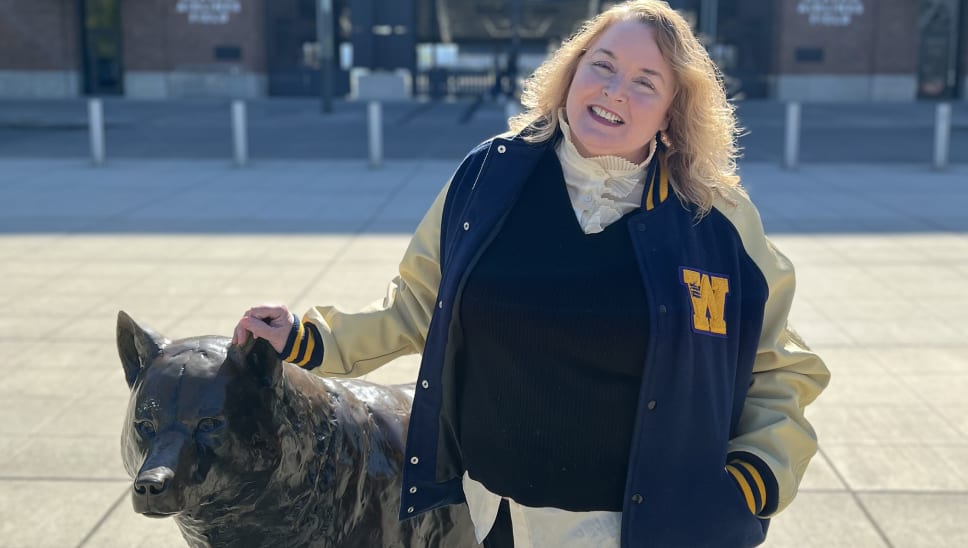
Many people who were old enough to watch the 1972 Summer Olympics in Munich remember it for the shocking terrorist attack on members of the Israeli team. But Catherine “Cat” Clark was only 8 and watching the games on TV from her home in Yakima. To her, they were inspirational because many of the U.S. swimmers were from the University of Washington.
“I saw them and said, ‘I’m going to do that’,” she recalls. Nine years and a lot of hard work later, she was indeed recruited to swim at the UW.
Clark, 61, insists she’s not a natural athlete. “I have no hand-eye coordination,” she says, “and I am dyslexic.” When trying out for the local swim team in Yakima, she says, she could not swim the width of a six-lane pool. But, she says, “I can control this body, and I have hypermobile joints, and that gives me a huge advantage in the water.”
Swimming is in her blood. As a youngster, Clark’s mother swam in summer league in Stone Harbor, New Jersey; her cousin’s son is Brendan Hansen, a six-time Olympic medalist and former world breaststroke record-holder.
Although Clark wanted to pursue a career in the arts, her late mother and their next-door neighbor—John Morey Maurice, a professor of law at Gonzaga University—had other ideas. Clark’s mother, possibly worried about her daughter’s future, conspired with Maurice and “dared” her to go to law school. “So I had this other person in my life telling me that I could do something I’d never even thought of,” Clark says, referencing Maurice, who became a mentor.
During her second year at Gonzaga, Clark was hired for a clerkship at the state Supreme Court, where she found another mentor in the late Justice Robert Brachtenbach. He advised her to choose a city she liked and set up a practice. Clark decided on Seattle, where she has been a litigator and handled appellate cases for more than three decades.
Clark’s own “career” in mentoring began around 2006, when she started to volunteer with the athletic department at her alma mater. She and other alumni from UW’s swimming program advised new swim coaches, and when the program was cut in 2009 (a self-funded program started back up in 2022), she hired three of the swimmers as interns. “I needed help in my practice, they needed a job,” she says. Her mentoring became about hiring student athletes as interns, even if they didn’t have a strong interest in the law.
“As my experience has taught me, having an older person take an interest in a young person’s future, whatever that future may be, makes a huge difference,” says Clark.
In the spring of 2015, she received a call from Damon Huard, a former UW football player who had returned after a career in the NFL to fundraise for his alma mater’s athletic program, then became the football team’s chief administrator. Huard sent player Hayden Schuh to talk to Clark about his interest in becoming an attorney, and Clark hired him to work as a summer intern.
Today, Clark’s roster of interns includes student athletes from a number of UW sports programs. Two qualified last fall for what Clark calls her “injured players” internship. She makes sure her interns focus on studies and sports before showing up to work, where they may help with research or with fine-tuning the practice’s online presence. Whatever their situation, says Clark, “we adjust to them.”
Though it isn’t Clark’s mission to teach them to be lawyers, five of her former interns are now practicing attorneys. “I teach them what it is to be a leader,” she says. “All lawyers are leaders by definition. It takes courage to step into some scary situations as a lawyer, which is what they’re doing on the football field or the basketball court or in the pool.”
Cat Clark’s Advice on Becoming a Mentor
Volunteer … later: “The practice of law is a long road, and we must maintain commitment to our families,” says Clark, who began to mentor in her early 40s. “Learn the craft first. There will be plenty of time in your career to pay it forward.”
Explore your community: While Clark eventually focused her mentoring efforts on student athletes, she has been involved with several organizations and recommends attorneys reach out to their communities: “Big Brothers Big Sisters is a great place to go. There are foster youth all over this country that could use some help.”
Feel the love: Having been mentored herself, Clark thought she knew what to expect when she began to pay it forward. But she was surprised by how much her heart expanded. “Being around these young people makes my heart sing,” says Clark.
Search attorney feature articles
Featured lawyers
Helpful links
Other featured articles

Mary Catherine Fons gives consumers a fighting chance

First in the forest, now in the courtroom, Rod Nelson fights wildfire

How Ty Kelly launched a mental wellness resource group at Baker Donelson
Find top lawyers with confidence
The Super Lawyers patented selection process is peer influenced and research driven, selecting the top 5% of attorneys to the Super Lawyers lists each year. We know lawyers and make it easy to connect with them.
Find a lawyer near you