


Published in 2025 Minnesota Super Lawyers magazine
By Trevor Kupfer on July 11, 2025
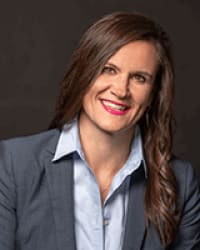
Aimée Dayhoff grew up in Seymour, Indiana, about an hour from Indianapolis to the north and Louisville to the south. Her close-knit family didn’t commonly travel to either. Instead, they visited their extended family’s farm, which they helped run.
“We had a huge garden, gigantic—feeding my grandma, grandpa, five siblings and their families,” recalls Dayhoff, whose father and grandfather ran an agricultural business, B&W Agri Products, selling equipment like grain bins, augers and dryers. “So we grew up doing lots of harvesting, canning and freezing. We had a little vineyard, peach trees, an old corn crib we played in, an outhouse, no running water, a barn with freezers and meat hooks and everything—we raised the cows and butchered our own meat. The first thing we started off doing pretty young was patting hamburgers, because we weren’t allowed to use the saws or grinders. It was a family affair, and some of my best memories.”
Much of the clan—including her brother, who now runs the business—remain near the family farm to this day. But not Dayhoff.
“Once I moved to D.C., and had that experience, I didn’t want to go back,” she says. “I wanted to see what else was out in the world. And that became even stronger when we lived abroad. It kind of changed my view of the world and my mindset. My parents have told me they knew the minute I graduated college I was never moving back.”

Now a shareholder at Winthrop & Weinstine in Minneapolis, Dayhoff may be far from the farm, but the farm is never far from her. Colleagues point to her relentless work ethic, the grounded way she relates to juries, and that she gravitated toward representing entrepreneurs and organizations like the Minnesota Zoo and Minnesota Grape Growers Association. They suspect her roots inform her approach to law.
“One hundred percent it did,” Dayhoff says.
Growing up in the Hoosier State, Dayhoff also grew up around basketball. It’s something she bonded over with former mentee Mary Riverso, who’s now an assistant U.S. attorney.
“She has the teamwork mentality from basketball,” Riverso says, “while also recognizing each person’s strengths and the role they can play on the team. She wants mentees to not just do the right thing in the moment, but succeed in the profession. It can be easy to tell people what best practice might look like, but she’s one of those leaders who leads by example. She’s always putting in the work, treating people well and building lasting relationships.”
One day in fourth grade, Dayhoff announced she was going to become a lawyer. “I have no idea why, but it’s been that way ever since and I’ve never regretted it,” she says.
She’d never met a lawyer, but she loved to learn. “English, history, science, everything,” she says.
When she headed to Indiana University in 1992, Dayhoff majored in political science knowing she’d continue on to law school. “And I knew from the moment I was going to law school I was going to be a litigator,” she adds.
But first came a few unexpected turns.
As a junior, Dayhoff interned with Sen. Richard Lugar, who served as chair of the Senate Agriculture Committee. Coincidentally, a recent college graduate named David Dayhoff was working for the committee. They started dating, and, after Dayhoff completed her senior year, David headed to Bologna, Italy, as part of his master’s with Johns Hopkins School of Advanced International Studies. She joined him and spent the year as nanny to an Italian family’s 2-year-old, teaching her English. “I never had any ambition to be a teacher, but it was a great experience,” she says.
When the couple returned to D.C., Dayhoff got an executive assistant job at AEI, where she’d previously interned. This time, she worked for John Bolton.
“When John was going through the process of being confirmed to be the ambassador to the U.N. [in 2005], there were a lot of people who worked for him and had pretty unkind things to say,” Dayhoff recalls. “I had nothing but a wonderful experience with him.”
David was interning for Cargill’s lobbying office at the time, and since he spoke fluent Portuguese, they asked him to relocate. “So I deferred starting law school for a year and moved to Brazil,” Dayhoff says. There, she taught English at a language institute while learning Portuguese in her spare time.
Finally, in 1999, Dayhoff was back in the U.S. and enrolled at William Mitchell College of Law, her sights set on business litigation.
During this time, contracts professor Dan Kleinberger and Court of Appeals Judge Gordy Schumacher served as influential mentors. The former pushed her hard in class. “For some reason, he would keep me on the hot seat, so much so that people [would] leave class going, ‘What did you do to piss him off?’” Dayhoff says with a laugh. “He instilled a confidence in me that I otherwise might not have had. I knew I could hold my own.”
Schumacher pushed her to get on the law review and get published before helping her land her first—and, as it turns out, only—job at a Minnesota firm. She became a summer associate at Winthrop in 2001, and has stayed ever since.

In her first year of practice, she got to serve as third chair on a trial in which Bob Weinstine was running lead. The case involved the purchase of Hub Jewelers. “It was awesome because I got put on the case pretty quickly after I started,” she says. “But I want to say it settled the night before. I remember being so upset. Not that I was going to really be doing anything, but I wanted to go to trial. I remember Bob telling me, ‘Aimée, you’re going to have to get used to this, because this is what tends to happen.’ And, boy, was he right.”
Dayhoff would later represent the legendary Joe Friedberg in personal litigation, which she says led to a close relationship. Friedberg went on to send several opportunities her way. “Joe would always send me very interesting referrals,” Dayhoff recalls, citing one involving a thoroughbred horse trainer.
Her case work is dotted with novel matters, from repping the Ho-Chunk Nation in its Supreme Court to working with wineries. “I’m a learner so, for me, my career has been exciting and energizing. It’s never been boring,” she says.
As co-chair with Geoff Jarpe back in 2012, one of the first cases Dayhoff tried to verdict brought her overseas again—this time to Turkey to learn about the highly technical craft of wooden boat construction. “I remember he said, ‘I’m not going to Istanbul,’ and I was like, ‘Well I want to!’ So it was perfect,” she says.
They represented Windsor Craft against Vicem Yachts after it spent millions on wooden yachts that allegedly had faulty epoxy that developed cracks upon entering the water. After two years of litigation, the verdict came, in their favor, at around $10 million plus fees. Along the way, Dayhoff learned a lesson about courtroom delivery.
“[Jarpe] didn’t use scripts at all. I felt very fortunate to just watch him give the opening and closing statements,” she says. “I remember vividly having these scripts for my witnesses, and him saying, ‘Real trial attorneys don’t do that, Aimée.’ So I threw away the scripts and did it that way.”
Yet, with more experience, she now recognizes that different methods suit different lawyers.
“I do a script for my depos. I do a script for my directs, my crosses, all of that stuff. Do I always stick to the script? Absolutely not. But it’s part of my preparation,” she says. “That’s the beauty of practicing law. Everybody has different styles and practices that work for them.”
Dayhoff’s practice has also shifted over the years, with increasing focus on sale-of-business cases and employment litigation—something she never imagined herself doing. And although Dayhoff handles arbitrations from time to time, one thing she never sees shifting is her focus on trial work. “I love being in the courtroom,” she says.
A recent notable case began in spring 2021, when Waumandee State Bank filed a suit alleging breach of noncompete provision against Lake Shore III Corp. regarding a 2020 agreement in which Waumandee purchased Union Bank of Blair. Lake Shore agreed not to engage in endeavors such as soliciting customers or employees for five years. Yet, according to the suit, six loan officers and several loans were moved to a different Lake Shore branch rather than staying with the new owner.
Herb Lallemont, who was president and CEO of Waumandee until his retirement in February, says Dayhoff’s presence was felt from the very start of the three-week trial. “She was calm and composed, and very much in control of the courtroom. You could tell that from day one,” Lallemont says. “It was obvious she had a plan, whether it was questioning the witnesses or her opening and closing arguments. She was fantastic. A big part of what made the case was how organized she was.”
“That’s how she approaches a case,” says Andrew Escher, an associate at Winthrop who has worked with Dayhoff several times, including as second chair in this case. “She goes in with a script, but there’s no hesitation to deviate when it makes sense to. If everything goes according to plan, you can take it from A to Z, but it never goes that way, despite your best efforts, so you have to read and react to a situation. That’s where her spontaneity comes in and makes her so effective.”
Escher says she often told him, “Don’t get so wrapped up in your preparations that you’re ignoring what’s going on around you.”
“It’s easier said than done,” he says, “but she’s had a lot of experience and is clearly very comfortable thinking on her feet.”
Lallemont noticed how carefully Dayhoff laid out the facts, and didn’t demean the jury. “Aimée was down-to-earth. Instead of talking over the jury like, ‘You’re from the country and we’re from the big city,’ Aimée just talked nicely on a personal and professional level,” he says.
“She’s a very engaging presence in the courtroom and it makes a lasting impression, which is what you need when you’re making an opening statement to 12 people who don’t have a sense of what’s going on,” Escher says. “I think her upbringing in rural Indiana helps her relate to jurors in a case like this.”
In September 2024, the jury awarded about $176,000 in damages, as well as attorney’s fees. The case stands out to Dayhoff not for the size of the verdict, nor for being drawn-out and hard-fought, but for the jury.
“We could barely seat a jury because everybody knew the two banks that were fighting, and it’s a small county,” she says. “So we finally seat a jury, and you’re asking them to be there for three weeks, but they were so attentive. They were taking copious notes. They were engaged the entire time. And I frankly don’t know how they did it, because there were a couple of days where it was a slog. We were going through loan documents, and it was mind-numbingly boring. … It gives you faith in the jury system after witnessing that. ”
Another thing that made it rewarding was giving Escher his first trial experience.
“That was the first time I had a stand-up role in a trial. It was a great experience and it’s one I got because Aimée trusted me,” Escher says. “She’s more than willing to give others opportunities to show they’re able to rise to the occasion.”
Adds Riverso: “I feel very lucky to have been able to learn from her because she’s in the place I’d hope to be someday—both with the kind and volume of work, but also while being her best self outside of work.”
That excellence extends to Dayhoff’s personal style. “She stands out in a way that is professional, refreshing, genuine and something that encourages those practicing around her to also be their genuine selves,” Riverso says. “She has a creative eye, which comes through in both her personal style as well as her legal work.”
Outside the office, Dayhoff joined National Association of Women Business Owners and Greater Twin Cities United Way’s Women’s Leadership Group. “So much of it sounded like what I would listen to my dad talking about: the difficulties that affect small business owners. And then you add being a female business owner on top of it, and so it was just real. I think that’s what I love most about it,” she says. “I met so many women who were highly educated and motivated in the workforce. I’m still close to them now, and they’ve been great mentors for me.”
These days, she has fewer boards on her calendar, her son is in college, and her daughter is a senior in high school. Dayhoff is foreseeing life as an empty nester. “It’s crazy to think about, but it’s an exciting time for my kids. And this is why you have them: so they go spread their wings and become amazing human beings,” she says.
She hopes some of her impending free time will go toward travel—something she and her husband have always loved. Sitting in a meeting room on the 35th floor of Capella Tower in downtown Minneapolis, Dayhoff sports a tan thanks to a recent two-week trip with her kids to Italy and Spain. “It was beautiful—flowers everywhere, orange blossoms, orange trees, green, 70s. So to come back to this was awesome,” she says wryly, gesturing to the snowflakes falling in April.
“But it’s OK. I have a trial in three weeks in federal court in North Dakota, so what else would I be doing?”
Have a Day Off? Dayhoffs Will Travel
Dayhoff and her husband David love traveling to food- and wine-rich destinations like Chile, Portugal, France and Napa Valley. “But every place I’ve been, I’ve loved for different reasons,” she says. These are her favorites:
- Argentina
- Morocco
- Croatia
- Kenya

Search attorney feature articles
Featured lawyers
Helpful links
Other featured articles

Outdated laws never die, but they don’t always fade away, either

How to prepare for your initial legal interview

How to ensure loved ones can access everything from online bank accounts to social media accounts
Find top lawyers with confidence
The Super Lawyers patented selection process is peer influenced and research driven, selecting the top 5% of attorneys to the Super Lawyers lists each year. We know lawyers and make it easy to connect with them.
Find a lawyer near you